AI Search Monitoring Architecture for Self-Hosted Teams
Being excluded from AI answers costs visibility that clicks no longer deliver.
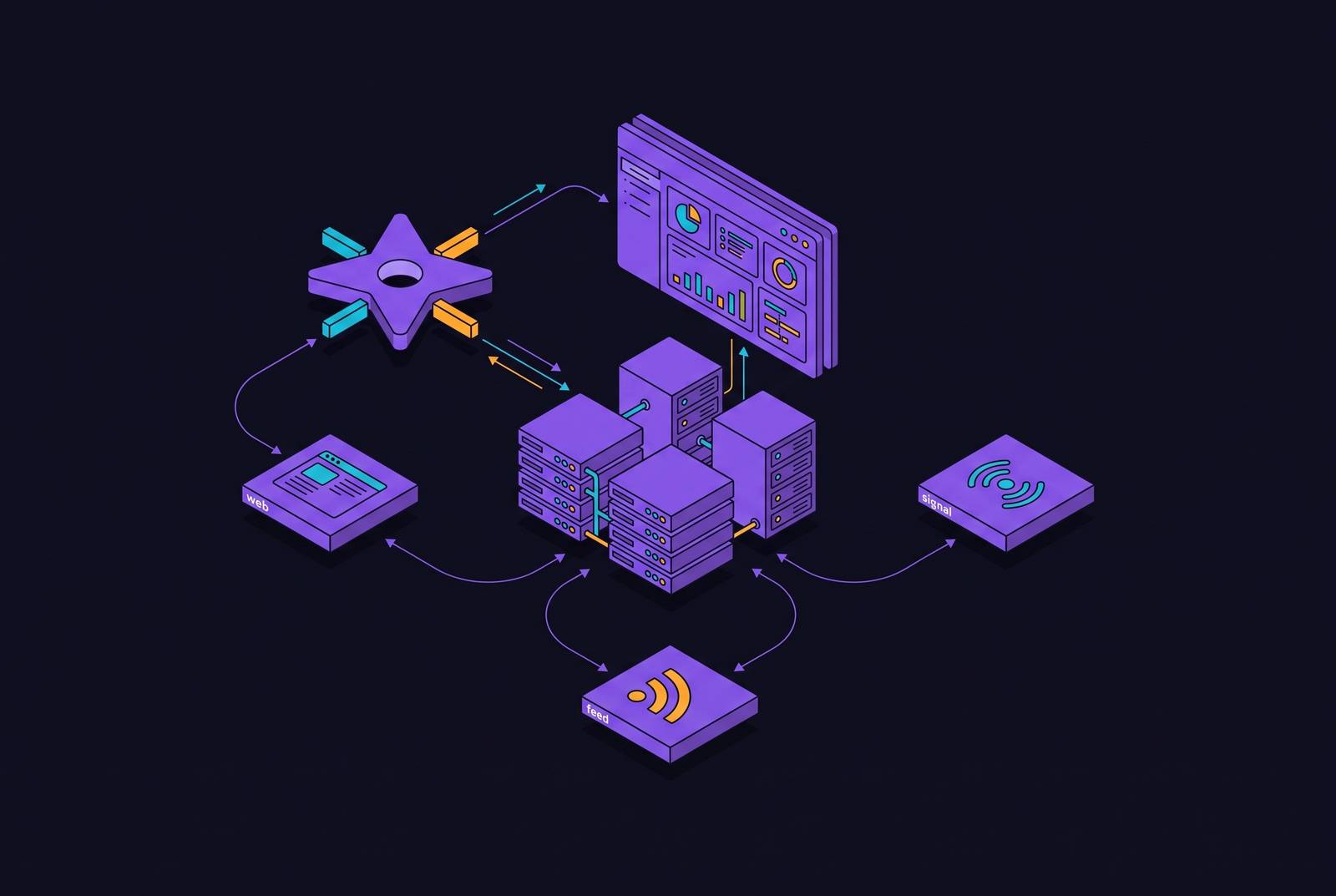
AI assistants now decide which brands a buyer hears about before that buyer ever visits a website, and that shift turns brand monitoring into an engineering problem rather than a reporting task. Traditional search hands a user a ranked list and lets them do the evaluating. Generative search collapses that list into one synthesized answer that names a handful of brands and quietly drops the rest, so the competition moves from ranking position to simple inclusion.
The scale involved makes this a structural change rather than a passing trend. Google AI Overviews reach an enormous global user base, ChatGPT serves hundreds of millions of users every week, and Perplexity handles hundreds of millions of queries each month. At that volume, being left out of an AI answer is a real visibility gap for any brand that depends on discovery.
Traffic patterns make the stakes sharper still. Most Google searches now end without a click, and that zero-click rate climbs even higher once an AI Overview appears on the page. That means getting cited inside an AI answer is becoming more valuable for initial discovery than getting clicked on a results page. Bright Data's open-source tracker documentation shows that the visits that do arrive from AI search also convert at a notably higher rate than traditional organic traffic, so the quality of those visits raises the stakes alongside their volume.
Most businesses have no idea where they stand in this new environment, and part of the reason is technical rather than strategic: default bot-protection settings silently block the crawlers that AI systems use to gather information, so a brand can be invisible in AI answers regardless of how good its content is. Fixing that takes infrastructure. The rest of this piece is about the architecture that can.
What a self-hosted monitoring stack needs to measure
Before choosing any tool, a monitoring stack needs a clear answer to a simpler question: what exactly is it measuring? Effective AI brand monitoring rests on four distinct metric types, visibility, share of voice, sentiment quality, and citation sourcing, and leaving any one of them out produces blind spots that quietly mislead strategy.
Visibility is the baseline: whether a brand shows up in a given AI response at all, counted per model and per prompt, tracked over time, but it says nothing about how well the brand is represented once it does appear.
Share of voice goes a step further. AI SOV measures brand mentions as a share of total category mentions across a set of tracked prompts, calculated as brand mentions divided by total category mentions times 100. The formula itself is simple, but it only works if competitors are tracked inside the same prompt runs rather than in separate sessions run at different times. A strong AI SOV position and a weak one represent materially different competitive situations, so teams need a threshold-aware view rather than a raw count sitting on its own. Teams operating at enterprise scale, tracking priority queries across several AI platforms every week and comparing against multiple named competitors, generate data volumes that no amount of manual prompting can keep up with.
Sentiment and recommendation quality catch what raw mention counts miss. A brand named once as a passing alternative and a brand actively recommended across a multi-turn conversation register identically in a simple citation count, even though they represent completely different outcomes for the business. Somantra's three-score framework illustrates what a complete, sentiment-aware model looks like: Brand Mindshare covers share of voice and citation share, Brand Consideration measures the strength and favorability of a brand's positioning relative to named competitors within a response, and Brand Engagement tracks the depth of engagement across multi-turn conversations. Rentomojo, an Indian furniture and appliance rental platform, applies these scores through Somantra's AEO Metrics Suite to see which buyer-intent conversations recommend it and which don't, broken down category by category, which shows how sentiment-level detail can drive actual content decisions.
Citation sourcing closes the loop. A mention names a brand inside an answer, while a citation links that answer back to a specific source, and a monitoring stack needs to track both separately, because the sources feeding AI answers matter just as much as whether a brand gets named. PR Newswire's AEO & GEO Brand Report is built around exactly this three-layer structure: mentions (share of voice, ranking position, model-specific visibility, and trend tracking over time), sources (the domains and URLs shaping AI-generated answers), and answers (the actual LLM responses themselves). This matters because the large majority of brand mentions inside AI answers trace back to external websites, PR coverage, reviews, comparison articles, and industry press, so citation sourcing data doubles as a signal for where to prioritize PR and content work.
How each AI model surfaces brands differently
Every AI engine weighs sources and retrieves information differently. The same prompt can produce completely different brand visibility depending on which model answers it. A monitoring stack built around a single model captures one distorted slice of the picture rather than the full competitive landscape.
The differences between engines follow distinct patterns, worth knowing in detail. ChatGPT has historically favored well-structured documentation, FAQ pages, and canonical product pages. Claude tends toward longer-form analysis and may weight premium journalism outlets (e.g., NYT, The Atlantic) and technical, expertise-dense content. Gemini draws on Google's search index authority signals. None of these behaviors is interchangeable with another, and a 2026 arXiv study comparing thousands of queries across Google Search, Gemini, and AI Overviews found average Jaccard similarity below 0.2 between their source sets.
The practical response is to monitor broadly rather than narrowly. Monitoring at least five platforms, ChatGPT, Claude, Gemini, Perplexity, and Grok, is recommended for a representative picture, and Bright Data's open-source tracker covers six at once: ChatGPT, Gemini, Perplexity, Grok, Copilot, and Google AI Mode.
Prompt sensitivity adds a second layer to the same problem. A single-word change to a query can shift which brand an AI assistant recommends as the safest or best-value choice. Somantra's perturbation testing across 4,445 ChatGPT responses found this pattern consistently, and a flat citation count never reveals that kind of volatility. AI Overviews compound the issue further, since they answer less consistently across repeated runs and react to small edits in query wording, so a single screenshot proves very little and teams need to repeat prompt runs and treat volatility itself as a metric.
Query design has to account for all of this by covering the full buyer journey rather than a single phrasing. That means building out category prompts ("best tools for X"), comparison prompts ("A vs B vs C"), problem-aware prompts ("how to solve Y"), and buying-intent prompts ("which tool for Z use case"), with a starting unified prompt set of 15–25 buyer questions drawn from these formats performing consistently across engines. Teams should also document how small wording shifts change results: "best email marketing tools" can surface different recommendations than "top email marketing platforms" or "email marketing software comparison." Stackmatix's 2026 AEO trends guide recommends querying ChatGPT, Perplexity, Gemini, and Claude before a single piece of content gets written, and documenting which sources get cited for each target query, treating prompt research as a prerequisite for content strategy rather than an audit performed after the fact.
One more caution belongs in the query design process: citation count alone cannot vouch for citation quality. A 2026 arXiv audit found evidence of AI-generated sources among a meaningful fraction of cited sources across real-world queries, so the stack needs to audit source credibility in addition to tallying whether a link shows up.
All of this points toward one architectural requirement. The query orchestration layer has to run the same prompt set across every tracked model in parallel, manage a growing library of prompt variations, and repeat those runs on a schedule to measure volatility over time rather than guessing at it from a single snapshot.
The query orchestration layer: running prompt variations across models at scale
Prompt variation management starts with treating prompts as a structured library rather than a single canonical question. Prompts should be organized by query type, category, comparison, problem-aware, and buying-intent, and by brand substitution pattern, so the same underlying question can run for every competitor in a category. Dynamic brand injection, using a placeholder like {brand} that populates automatically at run time, lets one prompt template generate competitor-parallel queries without manually duplicating every prompt for every brand. Bright Data's tracker uses exactly this pattern in its Prompt Hub, with {brand} injection driving batch runs across all six tracked models in parallel.
Before any of that runs on a schedule, prompts benefit from evaluation. Promptfoo, an open-source command-line tool for evaluating, comparing, and red-teaming LLM applications, runs locally with declarative test configuration, and it's built for systematically testing how different phrasings, contexts, and query structures change AI responses before those prompts get locked into a recurring monitoring run.
Parallel dispatch matters because querying six models sequentially introduces latency that makes continuous monitoring impractical; a well-designed orchestration layer dispatches to all models simultaneously and normalizes responses into a consistent schema regardless of per-model format differences. That normalization work is harder than it sounds. Perplexity returns markdown text with inline citation markers and stores its sources in a separate citations array. Gemini returns citations inside a structured object called grounding_metadata. Bing Copilot includes a response_raw field alongside its answer_text_markdown output. The orchestration layer has to absorb these differing formats so that whatever runs downstream sees one uniform input regardless of source [1][2].
Scheduling is where the probabilistic nature of these models becomes an architectural constraint rather than a curiosity. Because AI responses vary from one run to the next, a single query per prompt carries little statistical weight, so the orchestration layer needs to schedule repeated runs and record the variance between them to capture more than a point-in-time snapshot. Enterprise teams tend to run daily refreshes on their priority queries, while teams with a narrower scope often operate on a weekly cadence, and the scheduling layer should be built to support either without hardcoding one choice.
None of this works without solving access first. Querying ChatGPT, Gemini, Perplexity, Grok, and Copilot programmatically is genuinely difficult: every one of them renders through client-side scripting, blocks bots aggressively, differs structurally from the others, and in several cases responds differently depending on geolocation. Bright Data's GEO/AEO Tracker addresses this through Bright Data's LLM Scrapers, which fold residential proxy infrastructure, CAPTCHA handling, session management, response normalization, and polling for asynchronous responses into a single API call per model. The tracker's author notes that building and maintaining scrapers for all six models from scratch would take months of engineering work before a single line of tracking logic gets written. Teams that opt for direct API access where it's offered skip the scraping layer entirely, but they should know they may be looking at API-approximated responses rather than the exact answers a user sees in the interface, a distinction that matters for anyone monitoring real user-facing answer quality.
The orchestration layer's job ends once it produces a normalized, repeatable, parallel stream of raw responses. Everything that turns those responses into metrics happens downstream.
LLM observability as the tracing and evaluation backbone
Raw responses alone don't make a trustworthy monitoring system. A self-hosted stack needs an LLM observability layer to trace how each prompt executed, evaluate the quality of each response, manage versions of prompts over time, and leave behind an audit trail that makes metric trends interpretable.
Langfuse serves as the foundational open-source option for this layer. It covers tracing, prompt management, evaluation, and analytics in one system, and engineering teams can self-host the whole thing using Docker or Kubernetes at no software licensing cost. The project is MIT-licensed, and its cloud, self-hosted, and air-gapped deployments behave identically, with enterprise features like organization-level role-based access control available in the free distribution. Some enterprise compliance features, including SCIM, audit logs, and data retention policies, remain gated behind a commercial license. Langfuse was acquired by ClickHouse in January 2026, a move that signals deeper integration with columnar storage infrastructure going forward, which matters for teams planning to run analytical queries across large volumes of accumulated monitoring data.
This layer earns its place in the stack through three specific capabilities. Prompt versioning lets a team trace which exact prompt version was running at the moment a visibility shift occurred, and without that record, a trend in the data is nearly impossible to interpret correctly. Response-level evaluation scores each response for brand mention presence, mention position, competitor co-occurrence, and sentiment, and that requires a structured evaluation pass over raw model output, which Langfuse's evaluation framework provides without forcing a team to build a custom pipeline from nothing. Anomaly detection means that when a visibility score drops sharply between two runs, the observability layer surfaces the specific responses and prompts behind that drop instead of just showing an aggregate number, and that capability is what separates a system a team can debug from one that simply reports numbers with no explanation.
OpenObserve extends this picture at the infrastructure level, offering native LLM tracing and prompt management alongside infrastructure metrics like latency, error rates, and token consumption, all inside one observability interface. For a team that wants brand-level metrics and system-level health sitting side by side, that combination closes a gap that a brand-metrics tool alone would leave open.
Put together, Promptfoo evaluating prompts before they ever run, and Langfuse tracing what happens once they do, form the backbone that turns a stream of raw responses into a monitoring system a team can actually trust, audit, and improve over time.
Sources
- PR Newswire Launches AEO & GEO Report for AI Brand Visibility
- New AI Search Visibility Metrics for ChatGPT, Google AI Overviews, Claude, Gemini and Perplexity Launched - Somantra Sets Industry Standard for AEO and GEO Metrics Suite With Brand Mindshare, Brand Consideration and Brand Engagement Scores
- AEO Marketing Trends 2026: What's Changing in AI Search & GEO Strategy
- Open-Source AI Visibility Tracker With Bright Data